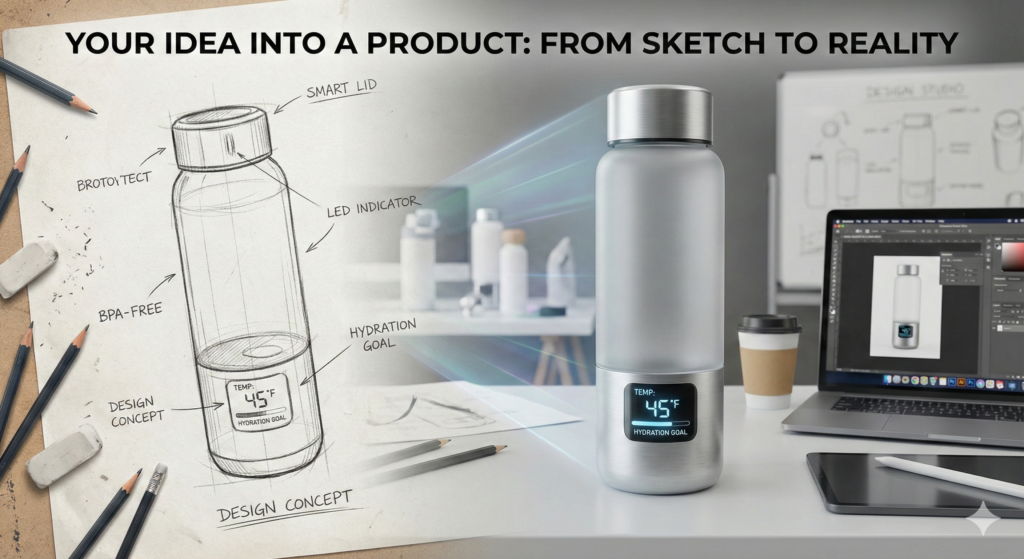
Idea for a Product: From First Sketch to Manufacturable Design
Published: February 5, 2026
Table of Contents
Key Takeaways
Introduction: Why a Product Idea Is Only the Beginning
Many inventors have a great idea but never see it become a successful product because they skip critical design-for-manufacture steps that make production economical.
Moving quickly from just an idea to a documented concept with market validation and manufacturable CAD files dramatically increases your chances of success.
3D DFM brings 30 years of design-for-manufacture experience, offering industrial design, CAD modeling, in-house 3D printing, and global manufacturer sourcing to help serious individuals and businesses create production-ready products.
While legal IP work requires a patent attorney, expert DFM consulting, prototyping, and manufacturer liaison can reduce costs by 40-60% before you commit to expensive tooling.
This guide provides a concrete, step-by-step process you can follow in 2024-2026, with examples from injection molding, sheet metal fabrication, die casting, and other common manufacturing processes.
Picture this: you wake up one morning in 2024 with a brilliant product idea—perhaps a compact medical sensor, a modular phone accessory, or an innovative industrial component. You can see it clearly in your mind. Fast forward 12-18 months, and ask yourself: will you actually hold that manufacturable product in your hand, or will it remain just an idea filed away in a notebook?
The hard truth is that most failures happen in the messy middle. Inventors and businesses stumble over poor documentation, skip market research, and create designs that look beautiful in CAD but are impossible to manufacture economically. According to industry data, roughly 90% of startups fail—and a significant portion of product-based ventures collapse because the concept was never properly translated into a production-ready design.
This guide focuses on physical products: consumer electronics housings, medical device enclosures, automotive brackets, industrial equipment, and similar items. If you’re in the business world trying to turn an invention into something you can actually sell, you’re in the right place.
At 3DDFM, we specialize in turning an idea into a product. Our expertise spans injection molding, blow molding, die casting, and sheet metal fabrication—the manufacturing processes that bring most physical products to life. With 30 years of experience, we’ve helped engineering teams and solo inventors alike bridge the gap between concept and production.
Here’s what we’ll cover:
Documenting and clarifying your product idea
Conducting market and IP landscape checks
Translating concepts into CAD and DFM-ready designs
Building and testing physical prototypes
Planning manufacturing, materials, and costs
Working effectively with manufacturers worldwide
How 3DDFM can serve as your design-for-manufacture partner
Step 1: Capture and Clarify Your Product Idea
Before you speak to designers, manufacturers, or potential investors, you need to get the idea out of your head and into concrete form. This is the first step that separates serious inventors from those with many ideas but no follow-through.
Practical Documentation Methods
Start simple. You don’t need expensive tools to capture your concept:
Documentation Method | What to Include | Why It Matters |
|---|---|---|
Dated paper sketches | Basic shape, key features, dimensions | Creates a paper trail for your inventor’s journal |
Google Docs specification | Problem statement, user needs, feature list | Easy to share and version-control |
Reference photos | Similar products, materials, environments | Helps designers understand your vision |
Voice memos | Quick thoughts and refinements | Captures ideas when you can’t sketch |
For example, imagine you’re developing a handheld medical sensor. Your initial documentation might include:
Target size: Fits in one hand, approximately 120mm x 60mm x 25mm
Environment: Clinical settings, must withstand cleaning chemicals
User interaction: Two buttons, LED indicators, charging port
Key differentiator: Faster readings than competitors by 40%
Establishing an Innovation Trail
Save dated PDFs to cloud storage. Keep version history. While these timestamps are not a substitute for formal patent protection through a patent attorney, they help establish when you first conceived the concept. If you ever need to find answers about who invented what and when, this documentation becomes invaluable.
How 3DDFM Helps at This Stage
We offer a short “concept framing” call where we help translate rough ideas into a high-level requirements brief. This call identifies critical unknowns, flags potential manufacturing challenges early, and ensures you’re not heading down a path toward a product that can’t be made economically.
Step 2: Check the Landscape – Market and IP Basics
Before spending serious money on tooling or engineering, you must confirm two things: your idea solves a real problem people will pay for, and it doesn’t obviously infringe on existing patents.
Conducting Market Research
Start by researching similar products on platforms like Amazon, Alibaba, and industry catalogs. Look for:
Pricing patterns: What do competitors charge? What’s the target market willing to pay?
Materials and construction: What processes do existing products use?
Customer reviews: What complaints reveal unmet needs you could address?
Gaps in the market: Where are potential buyers being underserved?
This research helps you identify whether your great idea truly offers something the market wants. Many inventors skip this step and discover too late that similar products already exist—or worse, that nobody wants what they’re building.
Basic IP Research
Use these free resources for a first-pass patent search:
Google Patents: Search keywords related to your invention
USPTO website: Browse the United States Patent and Trademark Office database
EUIPO: Check European intellectual property records
Look for patents with claims that overlap your concept. Note patent numbers, filing dates, and whether they’re still active.
This research is not a substitute for professional advice. When things get serious, consult a patent lawyer for a comprehensive search and IP strategy. You may need to consider provisional patent applications or full patent pending status depending on your timeline and business plan.
What 3DDFM Provides (And What We Don’t)
We don’t provide legal services or file patents. That’s the domain of a qualified patent attorney. However, we can help you prepare:
Detailed technical descriptions
Professional CAD drawings and renderings
Use-case scenarios and functional specifications
These materials make your patent attorney’s work faster and more precise—and they’re equally valuable when you need to find investors or present to potential buyers.
Step 3: Translate the Idea into Concept and CAD Design
Here’s a reality check: manufacturers in 2024 don’t quote “ideas.” They quote from 2D drawings and 3D CAD models with clear dimensions, tolerances, and material specifications. If you want accurate pricing and realistic timelines, you need proper documentation.
From Sketches to Structured Concept Design
The transition from rough sketches to professional concept design typically includes:
Multiple configurations: Explore 2-3 design directions before committing
Exploded views: Show how components fit together
Ergonomic studies: Ensure the product works for your target audience
Packaging considerations: Will it fit in standard boxes? Ship economically?
CAD Tools and When to Partner
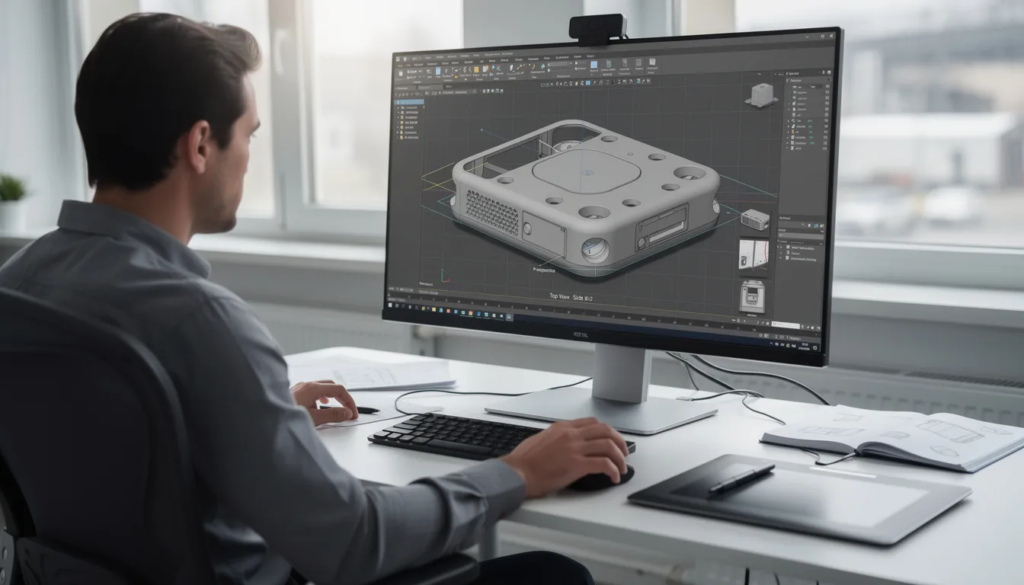
Tools like SOLIDWORKS, Fusion 360, or Creo are industry standards for building 3D models. However, learning CAD from scratch while developing a product is rarely cost effective. Unless CAD is your normal job, partnering with a specialist makes more sense.
3DDFM offers industrial design and CAD services to turn a one-page idea into detailed models. We handle internal structures, ribs, bosses, draft angles, and all the technical details that determine whether your design can actually be manufactured.
Design for Manufacture (DFM) from Day One
This is where most first-time inventors go wrong. They design what looks good without considering what’s economical to produce.
Key DFM Considerations:
Factor | Why It Matters | Example |
|---|---|---|
Part count reduction | Fewer parts = lower assembly cost | Combine housing pieces with snap-fits |
Standard fasteners | Easier sourcing, lower cost | Use M3 screws instead of custom hardware |
Realistic tolerances | Tighter isn’t always better | ±0.1mm costs more than ±0.25mm |
Material availability | Supply chain reliability | Choose ABS over exotic polymers |
Assembly access | Workers and robots need room | Design for automated pick-and-place |
Concrete Example: Consider a company that originally designed a two-part die-cast housing with machined mating surfaces and six screws. After DFM review, 3DDFM helped redesign it as a single injection-molded piece with integrated snap-fits. Result: eliminated machining operations, reduced assembly time by 70%, and cut per-unit cost by over 30%.
Good DFM decisions made early can save a million dollars over a product’s lifetime. Poor decisions often mean expensive tooling rework, missed launch dates, and products that cost too much to compete in their target market.
Step 4: Build and Test a Physical Prototype
A product prototype is critical for checking ergonomics, fit, assembly, and perceived quality. You simply cannot evaluate these things from CAD alone.
Prototyping Approaches
Different situations call for different methods:
Approach | Best For | Typical Cost | Timeline |
|---|---|---|---|
FDM 3D printing | Early form studies, fit checks | $50-500 | 1-3 days |
Resin (SLA) printing | Fine detail, smooth surfaces | $100-1,000 | 1-5 days |
CNC machining | Metal parts, functional testing | $500-5,000 | 1-2 weeks |
Silicone molds | Small batch production-like parts | $1,000-10,000 | 2-4 weeks |
In 2025 and beyond, desktop FDM and resin printers allow overnight iterations. But professional-grade equipment and finishing remain valuable for realistic, presentation-quality models that impress angel investors or business partners.
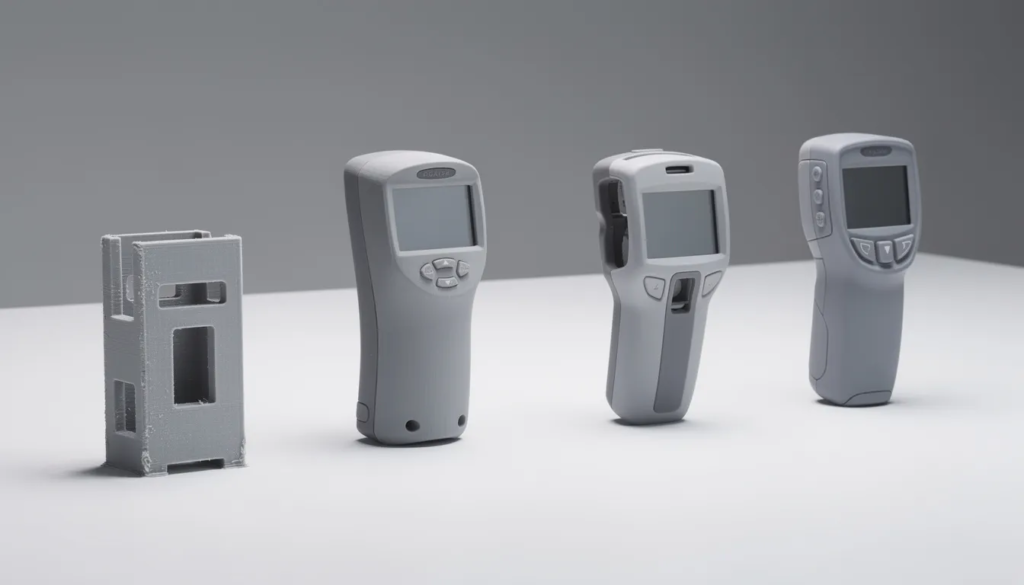
3DDFM has in-house 3D printing capabilities, enabling us to quickly turn CAD into tangible parts. This allows multiple design iterations before you commit to expensive injection molds or die-cast tooling.
Iterating Based on Feedback and Function
Good teams use prototypes as learning tools—not final products.
Example Scenario: An engineering team developing a handheld industrial scanner 3D-printed their first prototype and immediately discovered problems. The grip was too smooth for gloved hands. The main button was positioned awkwardly for left-handed users. The battery door didn’t provide enough tactile feedback when closed.
After testing with actual users during the process of developing medical devices, they revised:
Added textured grip zones
Repositioned buttons for ambidextrous use
Redesigned the battery latch mechanism
This prototyping phase identified issues that would have cost tens of thousands to fix after tooling.
Structured Testing Should Include:
Dimensional verification against CAD specifications
User feedback sessions with your target audience
Performance testing (temperature cycling, drop tests, vibration)
Assembly time studies
Documentation of every finding back into CAD
3DDFM can coordinate additional prototype types—silicone molds or low-volume CNC runs—when you need closer-to-production material behavior before committing to full tooling.
Step 5: Plan Manufacturing – Materials, Processes, and Costs
Once your minimum viable product prototype proves the concept works, you must select real production processes and build an initial cost model.
Common Manufacturing Processes
For physical products, these processes dominate:
Process | Best For | Typical Tooling Cost | Volume Sweet Spot |
|---|---|---|---|
Injection molding | Plastic housings, enclosures | $10,000-100,000 | 1,000-1,000,000+ units |
Blow molding | Bottles, hollow bodies | $5,000-50,000 | 10,000-500,000+ units |
Die casting | Metal structural parts | $15,000-150,000 | 5,000-500,000+ units |
Sheet metal fabrication | Brackets, panels, enclosures | $1,000-20,000 | 100-100,000+ units |
Choose based on:
Expected volume: Low volumes favor CNC or 3D printing; high volumes justify tooling investment
Required durability: Metal die castings for structural loads; plastics for lighter applications
Geometry constraints: Injection molding needs draft angles; sheet metal needs bend reliefs
Tooling budget vs. per-piece cost: Higher tooling investment often means lower per-unit cost
Materials selection impacts everything from regulatory approvals to strength to cost. For a consumer electronics housing, ABS offers good impact resistance at low cost, while polycarbonate provides better heat resistance but costs more. For die castings, aluminum offers excellent strength-to-weight ratio, while zinc allows finer detail at lower tooling cost.
3DDFM prepares manufacturable drawings and bills of materials that reflect realistic processes and materials, making it easier to obtain accurate quotes from manufacturers worldwide.
Budgeting and Feasibility
Before signing purchase orders, build a simple cost model:
Cost Model Components: For a comprehensive overview of our DFM services, including cost model considerations, explore our expertise.
Tooling cost: Mold or die investment (often $10,000-100,000 for injection molding)
Per-unit manufacturing cost: Material + labor + overhead per piece
Assembly cost: If multiple components require integration
Packaging and shipping: Often underestimated
Compliance testing: Regulatory certifications (especially for medical or automotive)
Target selling price: What the market will bear
Production Stage Economics:
Stage | Volume | Typical Approach | Per-Unit Cost |
|---|---|---|---|
Very low volume | 10-100 units | CNC or 3D printing | Highest |
Pilot runs | 100-1,000 units | Soft tooling or bridge molds | Medium-high |
Full production | 10,000+ units | Production tooling | Lowest |
3DDFM often works backwards from a target retail price to propose design and process changes that hit margin goals. If your business plan says you need to sell at $49.99 with 50% gross margin, we can analyze whether your current design achieves that—or what changes would get you there.
Common Budgeting Mistakes:
Underestimating tooling lead times (8-16 weeks is typical)
Forgetting packaging design and costs
Omitting compliance testing budgets
Assuming first-article samples will be perfect
Step 6: Prepare to Work with Manufacturers
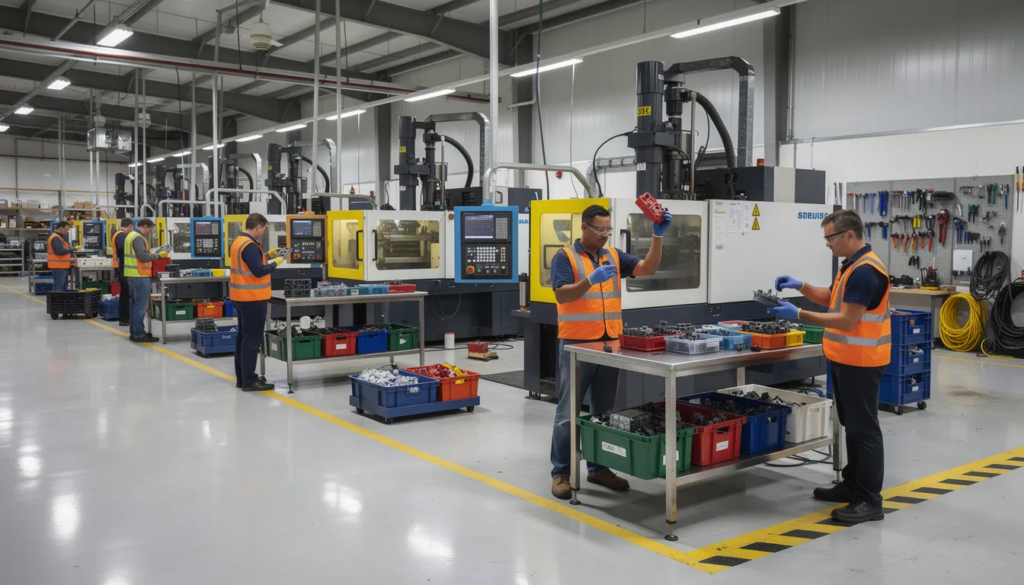
Approaching a manufacturer with a vague idea is a common cause of rejection and frustration. They receive countless inquiries from people who haven’t done their homework. Solid documentation makes collaboration smoother and gets you taken seriously.
What Manufacturers Expect
Document | Format | Purpose |
|---|---|---|
3D CAD files | STEP, IGES, native format | Quoting and tooling design |
2D drawings | PDF with dimensions and tolerances | Manufacturing reference |
Material specifications | Written specification | Sourcing and testing |
Surface finish requirements | Call-outs on drawings | Tooling and post-processing |
Volume and timeline | Written summary | Capacity planning and pricing |
Capacity planning and pricing
Protecting Your Work
Before sharing files with potential suppliers, use a disclosure agreement (NDA). Work with your legal counsel to ensure the language protects your intellectual property appropriately.
In 2024-2026, many manufacturers operate globally—in Europe, Asia, and North America. Vet potential partners through:
Factory audits (virtual or in-person)
ISO certifications (9001 for quality, 13485 for medical)
Customer references
Sample production runs
3DDFM has decades of experience working with manufacturers worldwide. We help clients filter quotes, clarify technical questions, and avoid common pitfalls like overcomplicated tooling or unrealistic tolerances.
Scaling from Prototype to Volume Production
Planning for growth requires different thinking at each stage.
Example Scenario: A startup validates their smart home sensor concept with 200 CNC-machined aluminum housings in 2025. Market response is strong. In 2026, they’re ready for a 10,000-unit injection-molded run with modified geometry optimized for the new process.
Key differences between pilot and production:
Factor | Pilot Batch | Series Production |
|---|---|---|
Tooling | Soft/bridge molds | Hardened steel molds |
Quality control | 100% inspection | Statistical sampling |
Logistics | Small shipments | Container loads |
Unit cost | Higher | Lower (volume efficiency) |
If your business plan assumes large-scale volume beyond the first 12-18 months, design for automation early. Parts that suit automated assembly or pick-and-place operations will scale more cost effectively than those requiring manual handling.
3DDFM advises clients on when it makes sense to redesign components specifically for high-volume manufacturing or assembly line integration.
How 3DDFM Helps Turn an Idea into an Economical Product
3D DFM serves as a specialist B2B partner for serious individual inventors, startups, and established engineering teams who want to create products that can actually be manufactured economically.
Core Services
Concept refinement: Translating rough ideas into structured requirements
Industrial design: Creating user-centered, aesthetically appropriate forms
CAD modeling: Building production-ready 3D models with proper tolerances
Design for manufacture reviews: Ensuring designs are economical to produce
In-house 3D printing: Rapid prototyping for testing and iteration
Manufacturer liaison: Helping you navigate global manufacturing partnerships
We bring 30+ years of experience across sectors including medical devices, consumer electronics, automotive components, and industrial equipment. Our expertise spans common processes like injection molding, blow molding, die casting, and sheet metal fabrication.
Digital Resources
Beyond consulting services, 3DDFM provides:
Ready-to-use CAD templates for common component types
Digital blueprints that accelerate design time
Courses for teams wanting to improve their internal DFM capabilities
These resources help clients standardize components and reduce design time and errors.
What We Do and Don’t Provide
We cannot replace a patent attorney. We don’t file provisional patent applications, conduct legal patent searches, or advise on trademark office registrations.
What we do prepare are the detailed technical materials—drawings, exploded views, functional descriptions—that patent lawyers and investors need to properly assess and protect your invention. This original design documentation is often the most important thing you’ll share with legal and financial professionals.
Typical Engagement Flow with 3DDFM
Here’s how a typical project unfolds:
Initial discussion: You share your concept; we assess feasibility and scope
NDA signing: Protecting your confidential information
Requirements capture: Documenting specifications, constraints, and goals
Concept sketch phase: Exploring design directions
CAD and DFM iteration: Building production-ready models
In-house 3D-printed prototypes: Testing and refining
Manufacturing quote support: Preparing documentation for supplier engagement
Projects range from focused two-week DFM reviews of existing designs to multi-month, end-to-end development of completely new product families.
We interface directly with your internal engineering and sourcing teams—or act as the primary technical partner for solo inventors and small startups. In 2024-2026, remote collaboration via cloud-based CAD reviews and digital handoffs to global manufacturers is standard practice.
Interested in learning more? If you have a serious product idea and need an experienced design-for-manufacture partner, visit 3DDFM.com to start the conversation.
Risks and Common Pitfalls to Avoid
Knowing what not to do can save years of effort and enough money to fund several product launches.
Common Mistakes That Sink Products
Mistake | Consequence | Prevention |
|---|---|---|
Rushing to factory without drawings | Rejected quotes, wasted time | Complete DFM documentation first |
Skipping market validation | Building something nobody wants | Research before heavy investment |
Choosing hard-to-source materials | Supply chain delays, cost spikes | Verify material availability early |
Ignoring regulatory needs | Product can’t be sold legally | Identify legal requirements upfront |
Over-customizing standard parts | Unnecessary cost and complexity | Use off-the-shelf components where possible |
Sharing unprotected ideas | IP theft, competitive exposure | Use NDAs; consult IP professionals |
Failing to consider manufacturing constraints early frequently leads to retooling, missed launch dates, and products that cost too much to compete. A company that wants to sell in a competitive market can’t afford per-unit costs that are 30% higher than necessary because someone didn’t understand injection molding requirements.
Sharing your concept widely without NDAs is risky. If you appear on Shark Tank without patent pending status, you’ve just disclosed your invention to millions. For more information on design for manufacture, as well as legal/IP protection, always consult legal professionals for IP and contract advice.
A partner like 3DDFM acts as a technical gatekeeper, identifying DFM and cost issues before they become large financial problems. Our best bet for your success is catching problems early—when fixing them costs hundreds instead of tens of thousands.
FAQ
These frequently asked questions address practical concerns not fully covered above, especially relevant for first-time product developers working through the steps involved in bringing an idea to market.
How long does it usually take to go from an idea to a manufacturable design?
For a typical small physical product, going from first concept to a DFM-optimized design with a tested prototype often takes 3-9 months. This depends on complexity, decision-making speed, and how many iterations you need.
Regulatory-heavy sectors like medical devices or automotive take longer due to additional testing, documentation, and compliance steps—sometimes 12-24 months to product completion.
3DDFM structures projects in phases so you can pause after each to decide whether to continue, pivot, or shelve the project based on learnings and budget.
Do I need a patent before I start working with 3DDFM?
No. You don’t need a granted patent before starting design and prototyping. Many inventors engage 3DDFM first to refine their concept and create professional drawings, then use those materials when working with a patent attorney on provisional or full applications.
That said, you should research similar products and consider an initial conversation with a patent lawyer early in the process. We sign NDAs and treat all client information as confidential, but we cannot provide legal patent advice or file applications.
What level of idea do I need before contacting 3DDFM?
You should have at least:
A clear problem statement (what pain point does your product solve?)
A basic vision of the solution (what does it do?)
Any existing sketches, reference photos, or competitor examples
We help clients ranging from those with only a rough concept to companies with partial CAD models needing DFM and prototyping support. Before your first consultation, try writing a one-page summary: who the product is for, what it does, and why it’s better than alternatives.
Can 3DDFM help me find and manage manufacturers?
We can recommend suitable manufacturing processes, prepare quote-ready drawings, and help you evaluate and communicate with suppliers worldwide. We have many years of experience working with factories across different regions and understand typical issues around lead times, quality, and communication.
However, we’re not a contract manufacturer. Final selection of suppliers and commercial terms remains your responsibility, often in consultation with your purchasing or legal teams. Think of us as your technical translator and advisor in the manufacturing relationship.
What types of products are the best fit for 3DDFM’s services?
Our strongest fit includes:
Plastic housings and enclosures
Instrument and device enclosures
Small mechanical assemblies
Medical and laboratory components
Automotive brackets, covers, and interior parts
Industrial equipment parts and panels
These products typically require CAD design, DFM optimization, and prototyping for processes like injection molding, blow molding, die casting, and sheet metal fabrication.
We also support companies that primarily need standardized CAD templates or design courses to accelerate their internal engineering workflows. Whether you’re a co founders team launching your first product or an established company expanding your line, our services scale to match your needs.
Manufacturing Engineering Services:
Injection Molding Design
Electronic Enclosure Design
Sheet Metal Design
Design for Manufacturing Consulting